
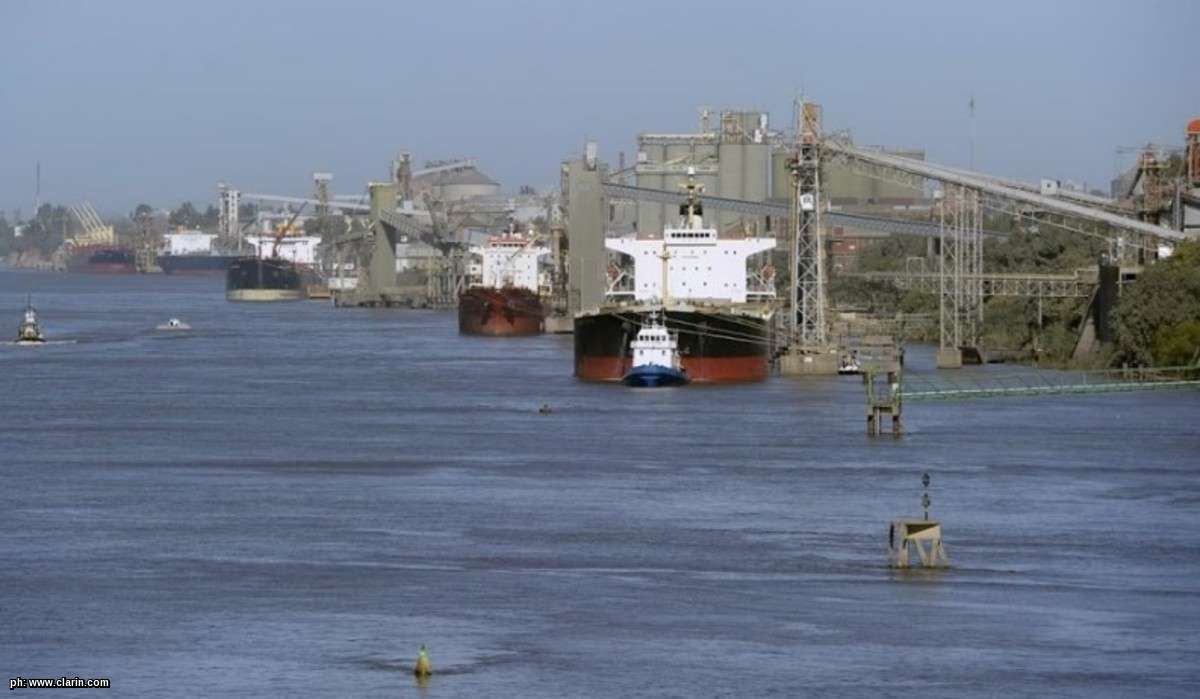
Pandi Liquidadores informs about a new modality adopted by the grain and vegetable oils port terminals mainly located along the Parana River affecting bulk carriers and tankers calling to those ports/terminals to load solid or liquid bulk cargoes.
a) In accordance with a circular issued by the Chamber of Private ports, they have informed that they shall cancel the berthing turn of those vessels that do not have approved cargo holds/tanks related to phytosanitary requirements and/or prevented from commencing loading operations for any given reason. In practice, this could mean significant economic losses for owners depending on the congestion of vessels in the area.
For your guidance we would like to describe the scenario as follows. The traffic of vessels is directed by Coast Guard Authorities through a department known as CONTRASE (Control of Traffic and Security) and it is divided for example in “Bajo Parana” (“Low Parana”) and “Parana Medio” (“Middle Parana”). The first area comprises for example the ports of Campana and Ramallo. The second one goes from Ramallo up to and inclusive San Lorenzo.
If the terminal is going to cancel the loading turn, then Coast Guard will decide where the vessel will go to. As to give you an example in San Lorenzo area, there are over 20 terminals but anchorage place for about 15 vessels. This means that in time of congestion the Coast Guard could even order the vessel to sail back to Recalada Pilot station which is in the outer River Plate meaning 30 hours of navigation down plus pilots and toll costs plus identical time and expenses to return to the designated terminal.
As we said this situation will very much depend on the availability of space in the nearby roads and congestion which usually takes place during the pick of the export season.
b) At the same time, Port Terminals, mostly located in the Ports of San Lorenzo and Rosario, have decided for the cases in which vessels delay loading operations preventing the use of their piers and facilities to unilaterally impose a “rate” (or rather a “penalty”) which in practice ranges from USD 1900 to USD 3,000 per hour, according to their “terms and conditions” for the use of terminals, for “lack of productivity”. This rate or penalty is claimed to owners and not to the person hiring the terminal (shipper). Recently even the seizure of vessels has been requested to guarantee the payment of said “rate”. Thus, for example, a vessel whose cargo holds was not approved and delayed its entry several days was arrested by the Terminal, which claimed the payment of the number of hours that they alleged that the pier was not productive. We understand that this “rate” or “penalty” established in the “terms and conditions” is a unilateral and arbitrary clause to the detriment of owners. These non-negotiated clauses are in our opinion abusive and even when the “terms and conditions” have been signed by agents and/or masters of vessels, said clauses are null and void, should have no legal effects and should be deemed as if not written since they are a restriction to the rights of the owner and an abusive extension of the rights of the terminal.
One of the terminals is alleging that due to the delay of a vessel in berthing due to rejection of cargo tanks condition, it was necessary to interrupt the production of their veg-oil/biodiesel claiming a huge compensation for business interruption.
For your guidance, we have received today from a local agent copy of the terms imposed for example by Cofco Terminal (attached hereto) which we trust you will find to be self-explanatory.
On the other hand, we would mention the main terminals which have adopted an aggressive approach on this are the following:
a) COFCO
b) San Benito
c) Renova
d) Vicentin
e) Terminal 6 (only when a vessel departure from the terminal is delayed for some reason alien to the terminal)
Bearing in mind the aforementioned then our suggestions would be as follows:
1) Inform Masters of the negative consequences of arriving at a port of loading with cargo holds in poor conditions (especially cleanliness). This shall mean losing their place in the line-up plus the additional costs, expenses and delays to be incurred depending where the vessel is directed to by the Coast Guard Authorities.
2) Inform Masters that they should not sign any documentation without consulting with her Owners first– specially, not signing terms and conditions of the terminals since they include abusive clauses.
3) In case there is no other option but to sign, we suggest that they do so in express disagreement with the terms. If the terms and conditions are in Spanish language then the Master should refuse to sign any document which he cannot understand.
4) Finally, if possible, we suggest that owners, when signing CP, foresee this item for “lack of productivity” in order to be held harmless for claims that should not be addressed to them bearing in mind that terminals are designated by charterers.
For your guidance this circular was drawn up after discussing with the Chambers Grouping Ships Agents in Buenos Aires and Rosario, with some local agents and with local law firm Ruggiero & Fernandez Llorente.
We will continue monitoring and looking into this new scenario keeping you duly posted on developments. Meantime, we remain at your disposal for any clarification and/or additional information that you may require.
Yours Faithfully
Pandi Liquidadores SRL, Buenos Aires / Argentina
Encls: Circular 013/2018 dated 31/08/2018 at https://drive.google.com/file/d/17c8Tv1D87Se45EOqSfRGpyet4baVm84e/view?usp=sharing
Notice: the content of this circular is for information only. Even though it has been issued carefully, and to the best of our knowledge, it has a general purpose and we can accept no liability whatsoever for any particular action taken upon it. © Pandi Liquidadores SRL 2018. All rights reserved.

![[UPDATE] CIRCULAR 36/2020 – SPEED REGULATION](https://pandi.com.ar/wp-content/uploads/2025/12/jV0QARlOmmDa1MjMKwnAoqO3inLwanRo.jpg)